Overview
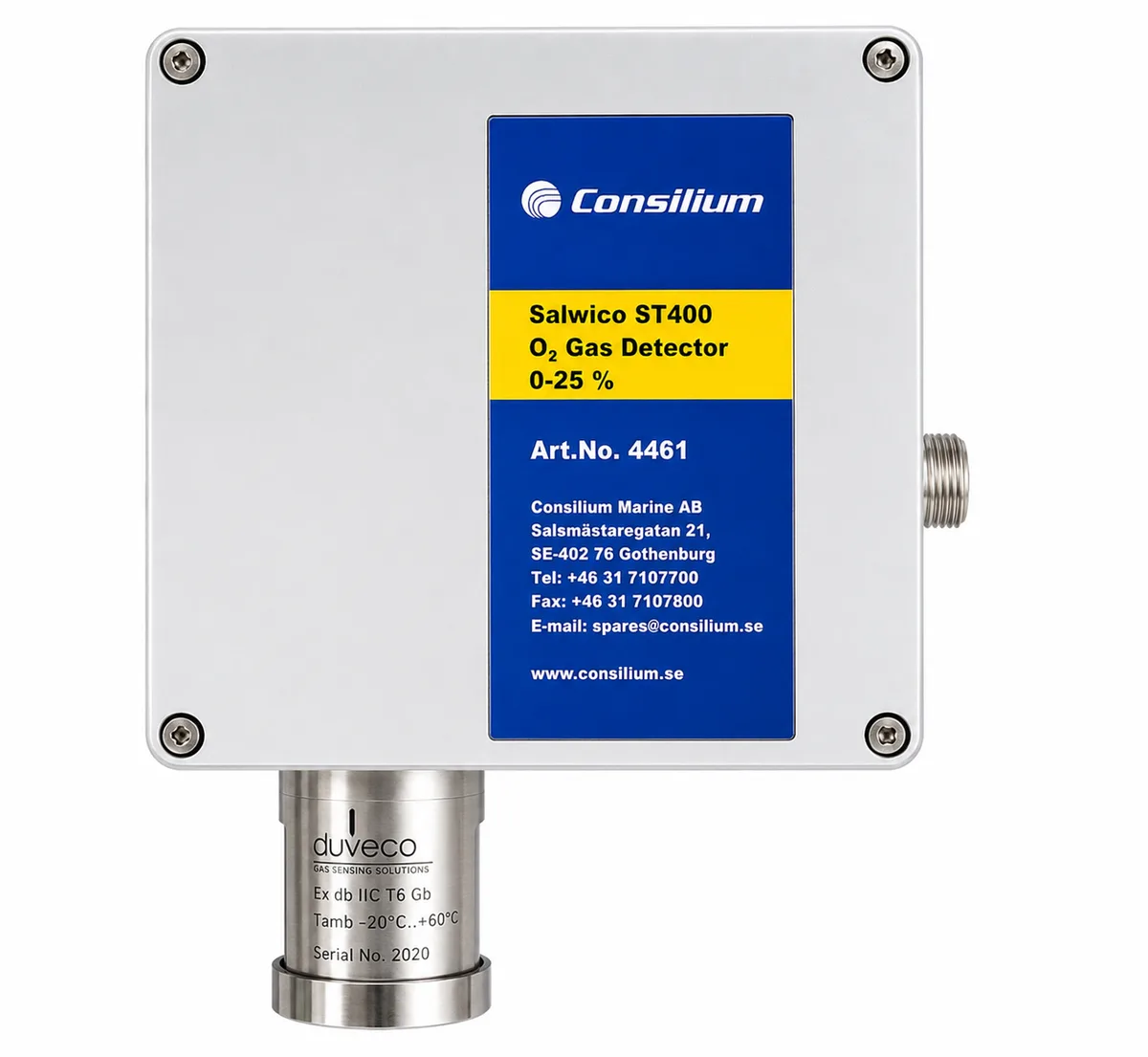
Consilium Salwico ST400 O₂ Gas Detector for Marine Oxygen Monitoring Systems
The Consilium Salwico ST400 O₂ Gas Detector is a fixed electrochemical oxygen gas detector designed for continuous monitoring of oxygen (O₂) concentration in marine and offshore environments. It helps detect oxygen deficiency or oxygen enrichment that could create hazardous working conditions in enclosed spaces, machinery areas, cargo compartments, and offshore installations. The detector provides a 4–20 mA two-wire output, features a corrosion-resistant marine-grade housing, and is compatible with Consilium Salwico GS3000, GS4, and SW2020 gas detection systems. Its one-man calibration design simplifies routine maintenance and ensures dependable long-term operation.
At Ship Care Service, we supply genuine Consilium Salwico ST400 O₂ Gas Detectors, replacement oxygen sensors, spare parts, calibration accessories, and technical support for commercial vessels, offshore platforms, FPSOs, and marine operators worldwide.
What is the Consilium Salwico ST400 O₂ Gas Detector?
The Salwico ST400 O₂ is a fixed oxygen gas detector that continuously measures oxygen concentration using an electrochemical sensing element.
The detector continuously samples the surrounding atmosphere and converts the measured oxygen concentration into a 4–20 mA analogue output signal, which is transmitted to the connected gas detection control panel. The detector is commonly configured with a 0–25% Vol O₂ measuring range, making it suitable for monitoring oxygen-deficient and oxygen-enriched environments.
Why is an Oxygen Gas Detector Important?
Both oxygen deficiency and oxygen enrichment present serious safety hazards onboard ships and offshore facilities.
The Salwico ST400 O₂ detector helps operators:
Continuously monitor oxygen concentration
Detect oxygen-deficient atmospheres
Detect oxygen-enriched environments
Improve confined space safety
Protect crew members during maintenance operations
Support safe cargo handling
Reduce workplace hazards
How the Consilium Salwico ST400 O₂ Gas Detector Works
The ST400 continuously measures oxygen concentration in ambient air.
Step 1 – Air Sampling
Ambient air naturally enters the detector through the sensor opening.
Step 2 – Electrochemical Measurement
The electrochemical sensor continuously measures oxygen concentration through a controlled chemical reaction, producing an electrical signal proportional to the oxygen level.
Step 3 – Signal Processing
The transmitter electronics convert the sensor signal into a standard 4–20 mA analogue output, allowing continuous communication with the connected gas detection controller.
Step 4 – Alarm Activation
When oxygen concentration moves outside the programmed safe operating limits, the gas detection controller activates:
Key Features
Continuous Oxygen Monitoring
Provides continuous measurement of oxygen concentration in hazardous marine environments.
Electrochemical Sensor Technology
Uses a high-accuracy electrochemical sensing element specifically designed for oxygen measurement.
Standard 4–20 mA Output
Provides a two-wire 4–20 mA analogue output for easy integration with marine gas detection systems.
One-Man Calibration
Supports direct field calibration at the detector head, allowing a single technician to complete calibration without additional adjustments at the controller.
Marine-Grade Construction
Manufactured with a chrome-plated ABS enclosure and stainless-steel sensor holder for reliable operation in demanding marine environments.
Compatible with Salwico Gas Detection Systems
The detector is designed for use with:
Typical Applications
The Consilium Salwico ST400 O₂ Gas Detector is commonly installed on:
Oil Tankers
Chemical Tankers
LNG Carriers
LPG Carriers
Offshore Platforms
FPSOs
Drill Ships
Offshore Support Vessels
Engine Rooms
Cargo Pump Rooms
Ballast Tanks
Confined Spaces
Void Spaces
Compressor Rooms
Industries We Serve
The ST400 O₂ detector is widely used across:
Marine Shipping
Offshore Oil & Gas
Shipbuilding
Offshore Energy
Marine Safety
Port Operations
Industrial Gas Detection
Marine Engineering
Who Uses the Consilium Salwico ST400 O₂ Gas Detector?
Typical users include:
Chief Engineers
Electrical Technical Officers (ETO)
Marine Engineers
Safety Officers
Cargo Officers
Technical Superintendents
Shipowners
Ship Management Companies
Offshore Maintenance Engineers
Why Choose the Consilium Salwico ST400 O₂ Gas Detector?
Marine operators choose the Consilium Salwico ST400 O₂ Gas Detector because it provides:
Continuous oxygen monitoring
Reliable electrochemical sensing
Accurate oxygen concentration measurement
One-man calibration
Standard 4–20 mA communication
Marine-grade durability
Easy integration with Salwico gas detection systems
Proven performance in commercial marine and offshore applications.
Technical Overview
The Consilium Salwico ST400 O₂ Gas Detector is a fixed oxygen gas detector designed for continuous monitoring of oxygen (O₂) concentration in marine and offshore environments. It is widely used to detect oxygen deficiency and oxygen enrichment, both of which can create hazardous working conditions for personnel.
The detector utilizes an advanced electrochemical sensing element to accurately measure oxygen concentration in ambient air. The measured oxygen level is converted into a standard 4–20 mA analogue output, allowing continuous communication with compatible marine gas detection control systems such as the Consilium Salwico GS3000, GS4, and SW2020.
Designed for reliable operation in demanding marine environments, the ST400 O₂ provides continuous atmospheric monitoring in enclosed spaces, machinery areas, cargo compartments, pump rooms, ballast tanks, and offshore installations.
Note: Measuring range, alarm set points, power requirements, and system compatibility may vary depending on the installed detector version and vessel configuration. Always verify equipment specifications using the detector nameplate and official Consilium documentation.
Main Components
The Consilium Salwico ST400 O₂ consists of several integrated components that provide reliable oxygen monitoring.
Electrochemical Oxygen Sensor
The electrochemical sensing element continuously measures oxygen concentration.
Its primary functions include:
Oxygen concentration measurement
Oxygen deficiency detection
Oxygen enrichment detection
Stable long-term monitoring
Sensor Housing
The corrosion-resistant housing protects the sensing element while allowing ambient air to reach the sensor.
Transmitter Electronics
The transmitter converts the sensor signal into a 4–20 mA analogue output for communication with the gas detection controller.
Calibration Interface
The detector includes a calibration interface that allows field calibration using certified calibration gas without removing the detector from service.
Mounting Assembly
The mounting bracket provides secure installation while allowing convenient access for inspection and maintenance.
Electrical Terminal Block
The terminal block provides connections for:
24 V DC Power Supply
4–20 mA Output Signal
System Ground
Communication Wiring
Working Principle
The ST400 O₂ continuously measures oxygen concentration in the surrounding atmosphere.
Step 1 – Air Sampling
Ambient air enters the detector through the sensor opening.
Step 2 – Oxygen Measurement
The electrochemical sensor continuously measures oxygen concentration by generating an electrical signal proportional to the oxygen content of the sampled air.
Step 3 – Signal Conversion
The detector electronics convert the measured oxygen concentration into a proportional 4–20 mA analogue output.
Step 4 – Alarm Processing
The gas detection controller continuously compares the received signal against preset alarm limits.
If oxygen concentration falls below or rises above the configured safe limits, the controller may activate:
depending on vessel configuration.
Advantages of the Consilium Salwico ST400 O₂ Gas Detector
Continuous Oxygen Monitoring
Provides uninterrupted monitoring of oxygen concentration in hazardous marine environments.
Accurate Electrochemical Measurement
The electrochemical sensor delivers stable and accurate oxygen concentration measurement for reliable personnel protection.
Fast Detection of Hazardous Conditions
Rapid detection of oxygen deficiency or enrichment improves emergency response and workplace safety.
One-Man Calibration
Supports quick field calibration by a single technician, reducing maintenance time and operational costs.
Standard 4–20 mA Output
Allows simple integration with marine gas detection systems and automation platforms.
Marine-Grade Construction
Designed to withstand:
Routine Maintenance
Routine maintenance helps ensure accurate oxygen monitoring and long detector service life.
Before Operation
Inspect:
Detector housing
Sensor condition
Power supply
Wiring connections
Alarm status
Verify normal operation before entering monitored areas.
Weekly Inspection
Check:
Detector cleanliness
Mechanical condition
Indicator status
Wiring integrity
Mounting hardware
Remove dust and contamination from the detector exterior if necessary.
Monthly Inspection
Inspect:
Carry out functional testing according to vessel maintenance procedures.
Annual Maintenance
Recommended maintenance includes:
Maintenance records should be documented in the vessel's Planned Maintenance System (PMS).
Common Operational Problems
Although the ST400 O₂ is designed for reliable operation, occasional issues may occur.
Problem: Sensor Failure
Possible Causes
Recommended Solution
Inspect the sensor and replace it if necessary.
Problem: No Output Signal
Possible Causes
Power supply interruption
Wiring fault
Internal electronics failure
Loose terminal connections
Recommended Solution
Verify the power supply, inspect field wiring, and test the transmitter electronics.
Problem: Incorrect Oxygen Reading
Possible Causes
Recommended Solution
Perform calibration using certified oxygen calibration gas and replace the sensor if readings remain inaccurate.
Problem: Communication Failure
Possible Causes
Cable damage
Loose wiring
Controller fault
Signal interruption
Recommended Solution
Inspect communication wiring and verify proper operation between the detector and gas detection controller.
Problem: Calibration Failure
Possible Causes
Recommended Solution
Use certified calibration gas, repeat the calibration process, and replace the sensor if calibration cannot be completed successfully.
Calibration Recommendations
Routine calibration is essential for maintaining reliable oxygen monitoring.
Calibration is generally recommended:
Every 6–12 months (or according to the manufacturer's recommendations)
After sensor replacement
After major maintenance
Following abnormal oxygen readings
During annual safety inspections
As specified in the vessel's Planned Maintenance System
Routine bump testing should also be performed according to company safety procedures.
Genuine Spare Parts Available
Ship Care Service supplies genuine replacement parts for the Consilium Salwico ST400 O₂ Gas Detector, including:
Availability depends on the installed detector configuration.
Buying Guide
Before purchasing a Consilium Salwico ST400 O₂ or replacement components, consider the following:
Verify System Compatibility
Confirm compatibility with the installed Consilium Salwico gas detection system.
Confirm Equipment Identification
Providing the following information helps identify compatible replacement parts:
Choose Genuine Consilium Components
Using genuine replacement parts helps maintain:
Accurate oxygen measurement
Reliable alarm performance
Long sensor life
Full system compatibility
Compliance with marine safety requirements
Work with an Experienced Marine Supplier
Choose a supplier capable of providing:
Why Marine Operators Choose the Consilium Salwico ST400 O₂ Gas Detector
The Consilium Salwico ST400 O₂ Gas Detector is trusted because it offers:
Continuous oxygen concentration monitoring
Reliable electrochemical sensing
Fast response to oxygen level changes
One-man calibration
Standard 4–20 mA communication
Marine-grade durability
Easy integration with Consilium gas detection systems
Proven performance in marine and offshore applications